What Defines a Robust Smart Home Network for Bangalore Homes?
A robust smart home network in Bangalore is the foundational infrastructure that ensures reliability, speed, and future-proofing for the diverse array of smart devices now commonplace in our densely populated urban environment. Moving beyond mere basic device control, this sophisticated network forms the backbone of true smart living, enabling seamless, automated experiences across security, lighting, climate control, and entertainment, even amidst the architectural challenges of multi-story apartments and sprawling villas. It's not just about getting devices online; it's about guaranteeing instantaneous communication, proactive troubleshooting, and sustained performance, critical for the high expectations of homeowners near areas like Manyata Tech Park or RMZ Ecospace.
Our Whitefield Success Story: From Network Nightmares to Seamless Smart Living
We recently engaged with an IT professional, Mr. Sanjay Rao, in Whitefield, living in a modern apartment complex notorious for its thick concrete walls and high Wi-Fi interference from surrounding units. Mr. Rao, like many in his profession working from home, had invested significantly in smart devices – a dozen smart lights, an intelligent thermostat, smart plugs, and a comprehensive security camera system monitoring his main entrance and balcony. His initial setup, reliant on a single, standard ISP-provided router, was a constant source of frustration: lights would often become "unreachable," security cameras would drop offline during critical moments, and his smart thermostat near Prestige Shantiniketan would lag significantly, leading to inefficient cooling and higher BESCOM bills.
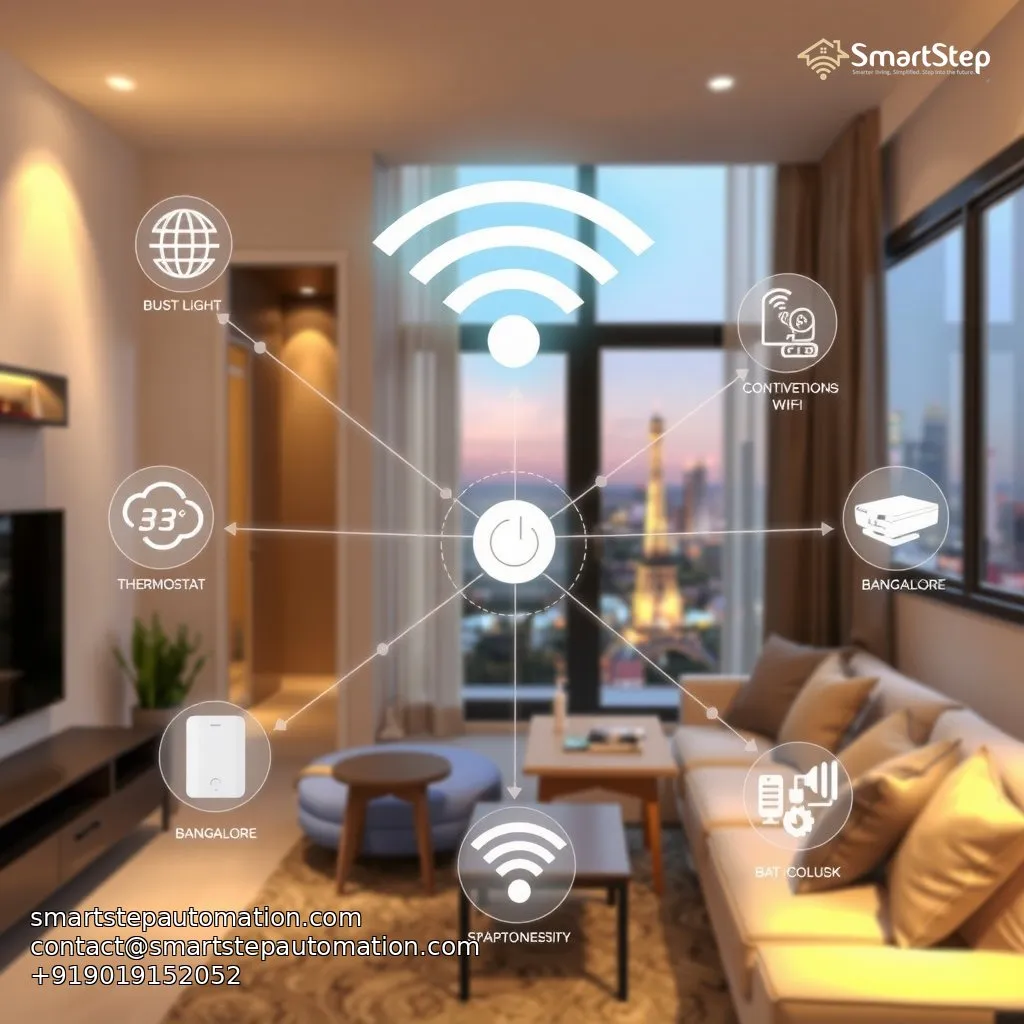
The SmartStep team conducted a comprehensive network audit, revealing significant dead zones, channel congestion, and an overloaded router struggling to manage over 30 connected devices. Our tailored solution began with installing a state-of-the-art Wi-Fi 6 mesh network, strategically placing nodes to blanket his entire 2500 sq ft apartment, effectively bypassing the signal attenuation caused by thick walls. We then integrated Matter-over-Thread compatible devices, such as his new smart locks and a new set of smart bulbs, leveraging Thread's low-power, self-healing mesh capabilities to create a dedicated, robust network segment independent of the Wi-Fi for these critical devices. This hybrid approach significantly reduced Wi-Fi congestion and dramatically improved device responsiveness. Mr. Rao now enjoys instantaneous smart lighting adjustments, real-time security alerts without delays, and a climate control system that precisely maintains comfort while optimizing energy usage. His home, once a battlefield of dropped connections, has been transformed into a truly smart, reliable ecosystem, a testament to what a well-engineered network can achieve even in challenging urban environments like Whitefield.
Smart Home Connectivity Protocols at a Glance
| Protocol | Primary Use Case | Range/Coverage | Power Consumption | Data Speed | Device Capacity | Bangalore Suitability |
|---|---|---|---|---|---|---|
| Wi-Fi 6 (802.11ax) | High-bandwidth devices, streaming, general internet | Medium-Large (up to 150-200 feet per access point) | High | Very High (Gigabits) | Very High (hundreds) | Ideal for large villas near Sarjapur Road or spacious apartments in Indiranagar; provides backbone for high-demand devices. |
| Mesh Wi-Fi | Whole-home coverage, eliminating dead zones | Large (extends coverage across entire property) | Medium-High (per node) | High (up to Gigabits) | Very High (hundreds) | Excellent for multi-story homes in Hebbal or sprawling layouts in Whitefield with thick walls. |
| Matter (over Thread) | Interoperability, low-power devices, security | Medium (Thread forms a self-healing mesh) | Very Low | Low-Medium (250 Kbps) | High (hundreds) | Good for apartment retrofits or new builds focusing on seamless integration of diverse smart sensors, locks, and lighting with minimal latency. |
| Matter (over Wi-Fi) | Interoperability, higher-bandwidth Matter devices | Medium-Large (dependent on Wi-Fi router) | Medium-High | High (Gigabits) | High (hundreds) | Best for existing Wi-Fi ecosystems in areas like Koramangala, bringing Matter compatibility to cameras, smart TVs, and more without new hubs. |
| Zigbee | Low-power sensors, lighting, mesh networking | Medium (forms a self-healing mesh) | Very Low | Low (20-250 Kbps) | Very High (thousands) | Perfect for dense smart lighting setups in any Bangalore home, offering robust, localized control. |
| Z-Wave | Low-power security, locks, sensors | Medium (forms a self-healing mesh, non-Wi-Fi) | Very Low | Very Low (40-100 Kbps) | Medium (232 devices) | Strong choice for security-focused homes in gated communities, offering reliable and secure communication for critical systems. |
The True Cost of Unreliability: A Bangalore Homeowner's Calculation
The "Cost of Unreliability" for a smart home network in Bangalore is far more substantial than many homeowners realize, impacting both their finances and peace of mind. A poorly configured or underperforming network doesn't just annoy; it generates tangible monetary and time losses.
Let's quantify this for a typical Bangalore homeowner in areas like Sarjapur Road, managing a dozen smart lights, a smart AC, and a few security cameras:
-
Wasted Electricity from Unresponsive Devices:
- Devices constantly trying to connect consume more power. A smart AC struggling to receive commands, or lights remaining on due to network lag, can add up.
- Calculation: If a smart AC runs an extra 30 minutes a day due to delayed commands (approx. 2 units/day extra) and various lights remain on an hour longer (approx. 0.5 units/day extra), that's 2.5 units/day.
- Monthly Cost: 2.5 units/day * 30 days * ₹8 (average BESCOM unit cost) = ₹600 per month.
-
Expenses for Frequent Troubleshooting Calls:
- Every time a smart device goes offline, requires re-pairing, or simply stops responding, homeowners often resort to calling technicians or spending hours themselves.
- Calculation: An average technician visit costs ₹500 - ₹1000. Assuming just one such issue requiring a call every two months.
- Annual Cost: 6 visits/year * ₹750 (avg.) = ₹4,500 per year.
-
Loss of Productivity Due to System Downtime:
- For IT professionals in Marathahalli or entrepreneurs in Indiranagar working from their smart homes, network failures disrupt concentration, video calls, and access to critical devices.
- Calculation: Assume 2 hours per month spent troubleshooting, resetting, or dealing with smart home failures that impact work (e.g., smart lighting for video calls, smart locks delaying entry). Valuing their time at ₹1,000/hour.
- Monthly Cost: 2 hours * ₹1,000/hour = ₹2,000 per month.
-
The Intangible Cost of Frustration & Insecurity:
- While difficult to quantify financially, the constant stress, inconvenience, and the feeling of insecurity (e.g., security cameras offline during monsoon season) significantly diminish the value proposition of a smart home. This leads to dissatisfaction and a perception of wasted investment. This affects overall well-being, which has an unquantifiable but very real cost.
Total Annual Cost of Unreliability: * Electricity: ₹600/month * 12 = ₹7,200 * Troubleshooting: ₹4,500 * Lost Productivity: ₹2,000/month * 12 = ₹24,000 * Total Estimated Annual Monetary Loss: ₹7,200 + ₹4,500 + ₹24,000 = ₹35,700
In contrast, a well-planned, robust network infrastructure, while an initial investment (often ranging from ₹15,000 to ₹50,000+ for a comprehensive mesh Wi-Fi 6 and Matter/Thread setup depending on home size and complexity), offers a rapid Return on Investment (ROI). By preventing these recurring costs, enhancing energy efficiency, ensuring security, and boosting productivity, such an investment often pays for itself within 1-2 years, all while delivering the seamless, frustration-free smart living experience that Bangalore homeowners truly desire.
SmartHomeBangalore #BangaloreTech #SmartConnectivityIndia #MatterOverThreadBangalore #WiFI6Home #SmartLivingBLR #BESCOM #WhitefieldSmartHome #HebbalTech #SarjapurRoadSmart
Ready to Automate?
SmartStep designs systems that grow with you.